Table of Contents
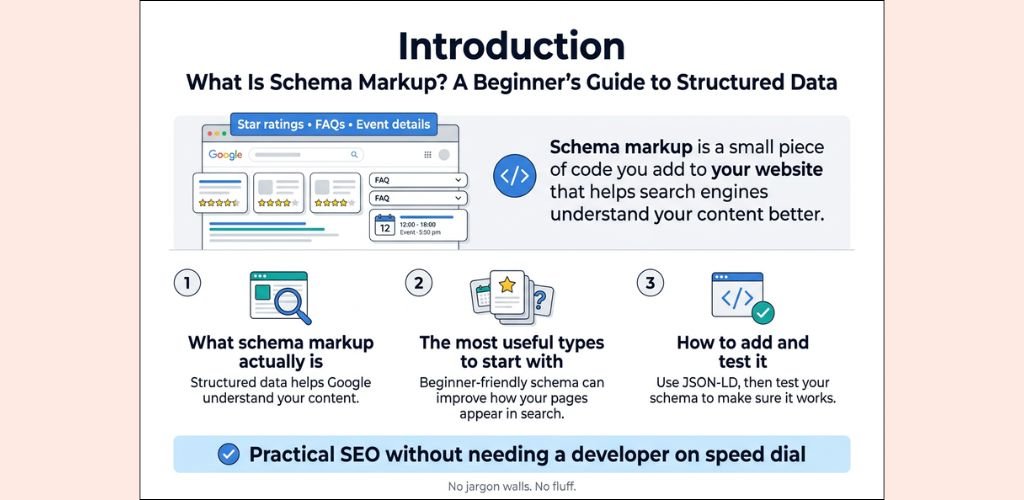
If you’ve ever searched Google and noticed star ratings, FAQs, or event details showing up right in the search results — that’s schema markup doing its job.
Schema markup is a small piece of code you add to your website that helps search engines understand your content better. It’s not just a technical nice-to-have. It’s one of the most practical ways to stand out in search results without chasing more backlinks or rewriting all your content.
This guide is written for bloggers, small business owners, and marketers who want to get more from their SEO without needing a developer on speed dial.
Here’s what we’ll walk through together:
- What schema markup actually is and why Google cares about structured data in the first place
- The most useful types of schema markup you can start with, even as a beginner
- How to add schema markup to your site using JSON-LD, plus how to test it so you know it’s working
No jargon walls. No fluff. Just a clear, practical breakdown of structured data SEO — so you can go from “I’ve heard of this” to “I’ve actually set it up.”
Let’s get into it.
Understanding What is Schema Markup and Why It Matters
What Schema Markup Actually Is in Simple Terms
Schema markup is a small piece of code you add to your website that tells search engines exactly what your content means — not just what it says.
Think of it like adding labels to a filing cabinet. Without labels, a search engine has to guess what’s inside. With schema markup, you’re spelling it out directly: “This is a recipe,” “This is a product,” “This is a review.”
It’s built on Schema.org, a shared vocabulary created by Google, Bing, Yahoo, and Yandex.
How Structured Data Communicates with Search Engines
Search engines read your page but don’t always understand it the way humans do. Structured data SEO bridges that gap by wrapping your content in a language search engines process fluently. Google explains this process in its introduction to structured data.
For example, JSON-LD structured data lets you define:
- Who wrote an article
- What a product costs
- When an event takes place
This clarity helps Google display rich snippets — star ratings, FAQs, prices — directly in search results.
Why Ignoring Schema Markup Puts You Behind Competitors
Websites using schema markup consistently win more visual space in search results. Rich snippets boost click-through rates, push competitors down the page, and signal authority to Google — all without changing a single word of your content.
How Schema Markup Works Behind the Scenes
The Role of Vocabulary from Schema.org
Schema.org is a shared dictionary created by Google, Bing, Yahoo, and Yandex. It defines standardized terms — called “types” and “properties” — that describe real-world entities like products, people, events, and recipes. When you use this vocabulary in your HTML, search engines instantly recognize what each piece of content means.
How Search Engines Read and Interpret Structured Data
Search engines crawl your page’s code looking for structured data markup. When they find it, they don’t just read your content — they understand it contextually. For example, structured data SEO tells Google that “4.8” isn’t a random number but a star rating, or that “Jan 15” is an event date, not just text on a page.
Also Read “Technical SEO Foundation“
Common structured data formats include:
- JSON-LD — Preferred by Google; lives in a script tag, separate from HTML
- Microdata — Embedded directly within HTML elements
- RDFa — Attribute-based, used in HTML tags
The Connection Between Schema Markup and Rich Results
Schema markup is what unlocks rich snippets in search results — those eye-catching stars, prices, FAQs, and breadcrumbs you see below certain listings. Google pulls structured data directly from your markup to build these enhanced displays, giving your listing more visual real estate and click-through potential.
Most Valuable Types of Schema Markup to Know
Article and Blog Post Schema for Content Creators
Article schema helps search engines understand your content’s author, publish date, and headline. This can trigger rich results showing article details directly in search, boosting click-through rates significantly.
Key properties to include:
headline– your article titleauthor– writer’s name and profiledatePublished– original publish dateimage– featured image URL
Product and Review Schema for E-Commerce Sites
Product schema is a game-changer for online stores. It surfaces star ratings, price, and availability directly in search results — giving shoppers key buying signals before they even click.
| Property | What It Shows |
|---|---|
price | Product cost |
aggregateRating | Star ratings |
availability | In stock status |
Local Business Schema for Boosting Local Visibility
Local business schema puts your address, phone number, hours, and reviews in front of nearby searchers. It strengthens your local SEO presence and feeds accurate data directly to Google Maps.
FAQ and How-To Schema for Capturing Featured Snippets
FAQ schema displays expandable questions directly under your search listing, taking up prime real estate on the results page. How-To schema shows numbered steps with images — perfect for tutorials and guides targeting rich snippets SEO opportunities.
Proven Ways to Add Schema Markup to Your Website
Explain JSON-LD and its advantages for structured data.
JSON-LD is Google’s recommended format for schema markup — and for good reason. You drop a script tag into your page’s <head>, and it stays completely separate from your HTML. No tangled code, no accidental breakage. Easy to update, easy to debug.
Using Google Tag Manager to Deploy Structured Data
If you can’t touch your site’s code directly, Google Tag Manager is your best friend. Just create a new tag, paste your JSON-LD script, set your trigger, and publish. No developer needed, and you can roll out schema across multiple pages fast.
Speeding Up the Process with Schema Markup Plugins
WordPress users have some solid options:
- Yoast SEO – handles basic schema automatically
- Rank Math – more granular control with minimal setup
- Schema Pro – built specifically for structured data, supports 35+ schema types
These plugins remove the guesswork, especially if you’re new to JSON-LD structured data.
Leveraging Google’s Structured Data Markup Helper Tool
Google’s free Markup Helper lets you highlight elements on any webpage and tag them visually. It then generates the schema markup code for you. It’s a great starting point when learning how to add schema markup without writing code from scratch.
Testing and Validating Your Schema Markup for Best Results
How to Use Google’s Rich Results Test Effectively
Google’s Rich Results Test is your go-to tool for checking if your schema markup is set up correctly. Just paste your URL or code snippet into the tool, and it’ll show you exactly which rich results your page qualifies for.
- Test both live URLs and raw code during development
- Check the “Detected Items” section to confirm your schema type is recognized
- Look for warnings alongside errors — warnings won’t break your markup but can limit rich result eligibility
Spotting and Fixing Common Schema Markup Errors
The most frequent issues with structured data SEO include:
| Error Type | Quick Fix |
|---|---|
| Missing required fields | Cross-check Schema.org’s required properties |
| Incorrect nesting | Validate JSON-LD syntax with a formatter |
| Mismatched content | Ensure markup reflects what’s visible on the page |
| Wrong schema type | Pick the most specific applicable type |
Google won’t display rich snippets for markup that violates its guidelines, so fix errors before publishing.
Monitoring Performance Improvements in Google Search Console
Inside Google Search Console, head to the Enhancements section to track your structured data health over time.
- Watch for spikes in impressions tied to rich snippet eligibility
- Monitor click-through rate changes after schema implementation
- Use the Performance report filtered by search appearance to isolate rich result traffic
Also Read “Complete SEO Guide for Beginners“
Real Benefits Schema Markup Delivers for Your SEO Strategy
How Rich Snippets Increase Click-Through Rates
Schema markup for beginners often feels abstract until you see rich snippets in action. When Google pulls star ratings, prices, or cooking times directly into search results, those listings visually stand out. Studies consistently show rich snippets can boost click-through rates by 20–30% compared to plain blue links — without changing your ranking position.
- Star ratings make review-rich results immediately trustworthy
- FAQ snippets answer questions before users even click
- Product prices and availability reduce friction in buying decisions
Gaining a Competitive Edge in Search Results
Most websites still skip structured data SEO entirely. That gap is your opportunity. Even if you rank similarly to a competitor, a rich snippet makes your listing more eye-catching and informative. Searchers naturally gravitate toward results that give them more information upfront.
Schema markup benefits extend beyond aesthetics — Google uses structured data to better understand your content, which can improve eligibility for featured snippets and knowledge panels.
Building Trust and Credibility with Searchers
When people see verified reviews, author credentials, or event details displayed right in search results, it signals legitimacy before they visit your site. JSON-LD structured data helps search engines surface that trust-building information accurately, making first impressions count where it matters most — the search results page.
FAQ”s
> What is the main purpose of schema markup?
Schema markup helps search engines understand your content’s context, not just its keywords. It bridges the gap between what you’ve written and what Google actually displays in search results.
> What is schema markup and how does it improve SEO?
Schema markup is structured data code added to your website that communicates meaning to search engines. It improves SEO by enabling rich snippets—star ratings, FAQs, prices—that boost click-through rates without directly changing rankings.
> How do schema markups help e-commerce websites rank higher?
E-commerce sites benefit from Product schema, which surfaces pricing, availability, and reviews directly in search results. This extra visibility attracts qualified buyers before they even click your link.
> How does structured data improve search engine visibility?
Structured data SEO works by making your content eligible for enhanced search features like knowledge panels, carousels, and featured snippets. These placements occupy prime real estate on results pages, driving more organic traffic.
> What are the different types of schema markup for websites?
Common types include:
| Schema Type | Best For |
|---|---|
| Article | Blog posts, news |
| Product | E-commerce pages |
| FAQ | Question-based content |
| Local Business | Physical locations |
| Review | Ratings and testimonials |
| JSON-LD structured data | Any page type (recommended format) |
Conclusion
Schema markup might sound technical at first, but once you get the hang of it, it’s one of the smartest things you can do for your website. From helping search engines understand your content to unlocking rich results that make your listings stand out, structured data gives you a real edge in a crowded search landscape. Whether you’re adding FAQ schema, product markup, or local business details, every little addition helps search engines connect your content to the right audience.
The best part? You don’t need to be a developer to get started. Use the tools available, test your markup, fix any errors, and keep building from there. Small steps add up quickly, and your SEO will thank you for it. So go ahead, pick one schema type that fits your content, and give it a try today.