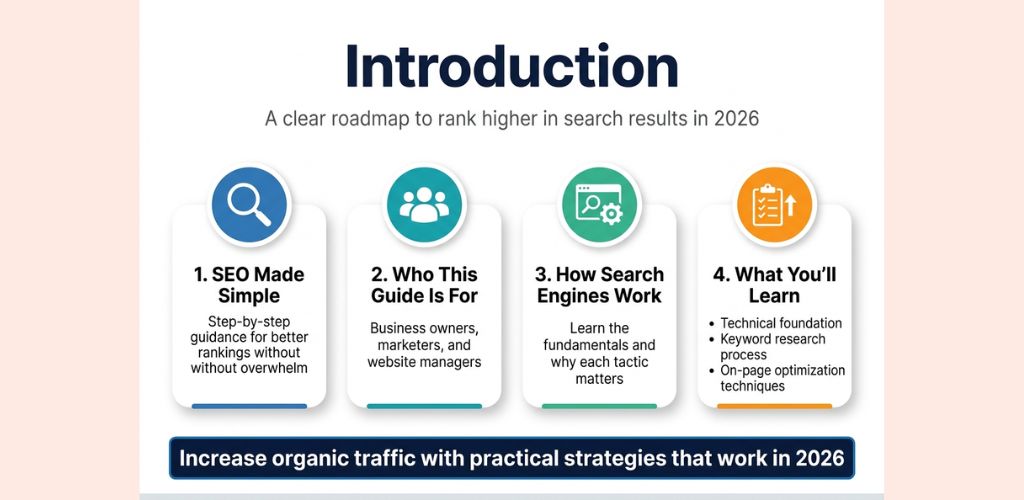
Learning how to do SEO for website step by step is essential for any business owner who wants to increase organic traffic in 2026. This comprehensive SEO guide for new websites breaks down the entire process into actionable steps, from technical setup to content optimization. Whether you’re following an SEO basics tutorial for the first time or looking for a complete website SEO checklist 2026, this guide covers everything you need to know about how to optimize website for Google rankings. By the end, you’ll understand exactly how to do SEO yourself without expensive agencies.
This guide is for business owners, marketers, and website managers who want to increase their organic traffic without getting lost in technical jargon or falling for outdated tactics. You’ll learn practical strategies that actually work in 2026, not theoretical concepts that sound good but don’t deliver results.
We’ll walk you through the essential SEO fundamentals and show you exactly how search engines work, so you understand why certain tactics matter more than others. You’ll discover how to set up the technical foundation that makes everything else possible, plus learn the step-by-step keyword research process that helps you target the right terms for your business.
Finally, we’ll cover proven on-page optimization techniques that help your content rank higher and attract more qualified visitors to your site.
Table of Contents
SEO for Beginners Step by Step: Understanding the Fundamentals
What SEO Is and Why It Matters for Your Business
Search Engine Optimization (SEO) is the practice of enhancing your website’s visibility in organic search results through strategic optimization techniques. When you learn how to optimize SEO for website performance, you’re essentially making your content more discoverable to search engines and, ultimately, to potential customers searching for your products or services.
How to do seo for website step by step matters for your business because it directly impacts your website’s ability to attract qualified traffic without paid advertising costs. Unlike paid marketing channels, effective SEO builds long-term organic visibility that continues generating results over time. This approach significantly reduces website SEO cost compared to continuous advertising spend while establishing your brand’s authority in your industry.
Understanding how to improve SEO for website performance enables businesses to compete effectively in digital markets, regardless of size. Search engines serve billions of queries daily, making SEO one of the most valuable marketing channels for reaching customers actively seeking solutions your business provides.
The Three Core Processes: Crawling, Indexing, and Ranking
Search engines operate through three fundamental processes that determine how your website appears in search results. Understanding these processes is essential when learning how to do SEO for website optimization step by step.
Crawling is the discovery phase where search engine bots systematically browse the internet, following links from page to page to find new and updated content. These automated crawlers analyze your website’s structure, content, and technical elements.
Indexing occurs when search engines process and store the information gathered during crawling. During this phase, search engines analyze your content’s relevance, quality, and context, then organize it within their vast databases for future retrieval.Ranking is the final process where search engines determine the order in which indexed pages appear for specific search queries. This complex algorithmic process considers hundreds of factors including content quality, user experience, and website authority.
The Three Pillars of SEO Success
Successful SEO strategy rests on three fundamental pillars that work together to improve search engine visibility. When you create SEO for website optimization, these pillars provide the framework for sustainable results.
Technical SEO forms the foundation, ensuring search engines can efficiently crawl, index, and understand your website. This includes optimizing site speed, mobile responsiveness, URL structure, and implementing proper schema markup.
Content Quality represents the substance of your SEO efforts. High-quality, relevant content that addresses user intent and provides genuine value consistently performs better in search results. This pillar focuses on keyword optimization, content depth, and user engagement. Authority Building involves establishing your website’s credibility and trustworthiness through various signals including backlinks, brand mentions, and user behavior metrics. Search engines view authoritative websites as more reliable sources of information.
Setting Realistic Timeline Expectations
SEO is a long-term strategy that requires patience and consistent effort. When learning how to increase SEO for website performance, understanding realistic timelines prevents disappointment and ensures sustained commitment to optimization efforts.
Most SEO initiatives begin showing initial results within 3-6 months, with significant improvements typically visible after 6-12 months of consistent optimization. However, these timelines vary based on factors including website age, competition level, and optimization quality.
New websites generally require longer to establish authority and rankings compared to established domains with existing search engine trust. Competitive industries may extend these timelines further, while less competitive niches might yield faster results.
Successful SEO requires ongoing maintenance and adaptation to algorithm updates, making it more of a continuous process than a one-time project. Setting appropriate expectations ensures you maintain the persistence necessary for long-term SEO success.
Website SEO Checklist 2026: Essential Setup Steps
Setting Up Google Search Console for Website Monitoring
Google Search Console (GSC) serves as your direct communication channel with Google, providing essential insights into how your website performs in search results. To set up GSC, start by visiting the Google Search Console website and adding your property using either the URL prefix method for specific domains or the domain property method for broader coverage.
Once verified, navigate to the “Indexing” > “Sitemaps” section from the sidebar. Your sitemap is usually located at either yoursite.com/sitemap.xml or yoursite.com/sitemap_index.xml. Paste your sitemap URL in the blank field and click “Submit.” After Google processes your sitemap, you’ll receive a confirmation message indicating successful submission.
GSC also provides valuable Core Web Vitals reporting. Visit the “Core Web Vitals” report to monitor your website’s performance across key user experience metrics including Largest Contentful Paint (LCP), Interaction to Next Paint (INP), and Cumulative Layout Shift (CLS).
Conducting a Comprehensive Technical SEO Audit
A thorough technical SEO audit reveals issues that could prevent search engines from properly crawling, rendering, and indexing your content. Technical SEO forms the foundation that determines whether your pages are eligible to appear in both traditional search results and AI-generated answers.
Start by examining your site’s crawlability using tools like Semrush’s Site Audit, which monitors over 140 technical SEO issues. Run a full crawl of your website and navigate to the “Issues” tab to identify problems such as orphan pages, broken links, and redirect chains.
Search for “orphan” to find pages with no internal links pointing to them, making it difficult for crawlers to discover them. Fix orphan pages by adding internal links from other relevant pages on your site.
Check for duplicate content issues by searching “duplicate content” in the audit results. While Google doesn’t penalize duplicate content, it can cause problems like undesirable URLs ranking in search results, backlink dilution, and wasted crawl budget.
Examine your robots.txt file (located at yoursite.com/robots.txt) to ensure you’re not accidentally blocking important pages. If you want visibility in AI-powered search experiences, verify that crawlers like OAI-SearchBot aren’t blocked, as many AI crawlers don’t execute JavaScript and rely on initial HTML responses.
This website SEO checklist 2026 ensures your technical foundation is solid.
Fixing Crawlability and Indexation Issues
Creating an SEO-friendly site architecture ensures search engines can efficiently discover and prioritize your content. Structure your site so all pages are just a few clicks away from your homepage, following a clear hierarchical organization that helps crawlers find content quickly.
Address JavaScript rendering issues if your site relies heavily on JavaScript frameworks or single-page applications. Unlike Google, many AI crawlers don’t execute JavaScript, so ensure critical content appears in the initial HTML response. Avoid blocking JavaScript files or resources needed for rendering in robots.txt, as this prevents Google from seeing important on-page content.
For indexation optimization, use noindex tags carefully, applying them only to pages you want excluded from search results such as thank you pages, PPC landing pages, internal search results, admin pages, or staging URLs. The noindex tag should be placed within the <head> section: <meta name=”robots” content=”noindex”>.
Implement canonical tags to resolve duplicate content issues. When Google finds similar content on multiple pages, canonical tags identify the original version using: <link rel=”canonical” href=”https://example.com/original-page/” />. Place this tag within the <head> section of duplicate pages.
Ensure only one version of your website (either https://yourwebsite.com or https://www.yourwebsite.com) is accessible to avoid duplicate content issues and backlink profile splitting.
Optimizing Core Web Vitals and Page Speed Performance
Core Web Vitals are essential metrics Google uses to measure user experience, directly impacting your search rankings. Focus on achieving optimal scores for three key metrics: Largest Contentful Paint (LCP) should be 2.5 seconds or less, Interaction to Next Paint (INP) should be 200 milliseconds or less, and Cumulative Layout Shift (CLS) should be 0.1 or less.
Use Google’s PageSpeed Insights tool to check your website’s current performance and receive a score from 0 to 100. The tool provides specific recommendations for improvement and evaluates both mobile and desktop performance.
Implement these page speed optimization strategies: compress images using tools like ShortPixel to reduce file sizes since images are typically the largest files on webpages. Deploy a content distribution network (CDN) to store webpage copies on global servers, connecting visitors to the nearest server and reducing load times. Minify HTML, CSS, and JavaScript files by removing unnecessary characters and whitespace to reduce file sizes and improve load times.
Ensure mobile-friendliness since Google uses mobile-first indexing, evaluating mobile versions of pages for indexing and ranking. Your mobile pages must contain the same core content, links, and structured data as desktop versions. Use PageSpeed Insights to verify mobile-friendly elements including meta viewport tags, legible font sizes, and adequate spacing around clickable elements.
Monitor your Core Web Vitals performance regularly using both Google Search Console’s dedicated report and Semrush’s Site Audit tool, which provides detailed Core Web Vitals analysis with specific recommendations for addressing any identified issues.
How to Do SEO Yourself: Keyword Research Tutorial for New Websites
Finding and Analyzing Target Keywords Using Free and Paid Tools
Effective keyword research begins with selecting the right tools for your specific needs and budget. Following this SEO basics tutorial, start with Google Keyword Planner, which remains completely free and excels for paid keyword research, offering forecasting features and budget planning capabilities. For organic keyword research, however, its limitations become apparent.
For advanced SEO professionals, Semrush provides granular keyword data with its free plan allowing 10 Analytics reports per day and 10 tracked keywords. The platform offers specialized tools including Keyword Magic Tool for exploratory research, competitive gap analysis, and keyword cannibalization reports. Its SEO Content Template tool creates content briefs and grades content in real-time for readability and SEO optimization.
KWFinder serves ad hoc keyword research needs well, limiting users to 5 searches daily but providing extensive data per search. Its standout feature is the keyword opportunities column, which identifies weaknesses in top-ranking results and suggests optimization strategies. The tool reveals content types currently ranking and provides searcher intent data for each keyword.
Ubersuggest focuses on content marketing with 3 daily searches in its free plan. It uniquely breaks out comparison keyword ideas and provides Content Ideas pulled from ranking results, including social media performance data from Facebook, Pinterest, and Reddit.
When evaluating tools, consider data comprehensiveness, keyword optimization guidance, free plan allowances, and standalone functionality. The best tools provide traffic data, keyword difficulty scores, and competitive SERP analysis without requiring additional paid extensions.
Understanding Search Intent for Better Content Alignment
Search intent represents the underlying purpose behind user queries, and aligning your content with this intent is crucial for ranking success. The reference tools reveal how different keyword variations serve different intents, which directly impacts how to optimize SEO for website performance.
Commercial intent keywords typically include terms like “new car lease” or “new car incentives” when searching automotive-related terms in finance contexts. These queries indicate users ready to make purchasing decisions, requiring content that addresses specific product features, pricing, and comparisons.
Informational intent appears in searches like “cars movie” or “disney cars” when the same automotive seed term is filtered through entertainment industry contexts. This demonstrates how industry selection dramatically affects keyword suggestions and their underlying intent.
Long-tail keyword variations often reveal more specific intent patterns. Users typing detailed phrases into search engines typically have clearer needs and are further along in their decision-making process. These keywords generally face lower competition and cost less in paid campaigns while being easier to rank for organically.
Understanding intent helps differentiate between keywords suitable for blog posts versus commercial pages. Informational keywords work best for educational content that builds authority and attracts top-of-funnel traffic, while commercial keywords should target product pages and conversion-focused content.
Tools like KWFinder specifically identify searcher intent for each keyword suggestion, making this analysis more straightforward. Content type analysis shows whether listicles, homepages, blogs, or product pages currently rank, providing insights into what format search engines prefer for specific queries.
Creating a Strategic Keyword Map for Your Website
A strategic keyword map organizes your target keywords across different pages and content types, ensuring comprehensive coverage without cannibalization. Start by categorizing keywords based on search intent and business relevance to create a logical site structure.
Primary keywords should align with your main product or service pages, while secondary keywords support these through blog posts and supporting content. Competition level analysis helps prioritize which keywords to target first—focusing on achievable wins while building authority for more competitive terms.
Industry-specific filtering capabilities in tools like WordStream’s Free Keyword Tool demonstrate how the same seed terms generate completely different keyword clusters. Selecting “Arts & Entertainment” for “cars” yields entertainment-focused results, while “Finance & Banking” produces commerce-oriented suggestions. This filtering ensures your keyword map reflects actual user behavior in your specific market.
Geographic targeting adds another layer to keyword mapping. Tools supporting location-based data help create region-specific content strategies, particularly valuable for businesses serving multiple markets or local audiences.
Competitive keyword analysis provides additional mapping opportunities. Entering competitor URLs reveals keywords they potentially profit from, which you can incorporate into your own strategy. This competitive intelligence helps identify content gaps and expansion opportunities.
The mapping process should account for content types currently ranking for target keywords. If product pages dominate results for certain terms, your keyword map should assign those terms to commercial pages rather than blog content.
Developing a Content Calendar Based on Keyword Opportunities
Content calendar development transforms keyword research into actionable publishing schedules aligned with business objectives and user needs. Keyword opportunity identification drives this strategic planning process.
Tools revealing keyword opportunities, like KWFinder’s weakness analysis, help prioritize content creation. When the platform identifies outdated content (over six months old) or missing keyword elements in current top results, these become immediate content calendar priorities.
Search volume fluctuations and seasonal trends inform publishing timing. Tracking how keyword search volumes change over time helps schedule content when user interest peaks, maximizing organic traffic potential.
Content Ideas features, available in tools like Ubersuggest, provide direct inspiration for calendar planning. These features pull successful content from currently ranking results, showing what topics resonate with your target audience and perform well across multiple platforms including social media.
Long-tail keyword research particularly supports content calendar development by revealing specific topics users actively search for. These detailed queries often suggest exact blog post titles and subtopics that address user needs comprehensively.
The calendar should balance different content types based on keyword intent analysis. Informational keywords support regular blog posting schedules, while commercial keywords may require less frequent but more detailed product or service content updates.
Competitive gap analysis reveals content opportunities your competitors haven’t addressed, providing unique angles for your editorial calendar. These gaps often represent the most valuable content opportunities since they face less direct competition.
On-Page SEO Optimization Techniques
Crafting Compelling Title Tags and Meta Descriptions
Title tags serve as the first impression of your content in search results, making them critical for both rankings and click-through rates. Keep your titles between 50-60 characters to avoid truncation and position your primary keyword near the beginning. For example, instead of “Learn About SEO Techniques That Work,” use “SEO Techniques That Drive Traffic: Complete 2026 Guide.”
Write title tags that are compelling yet accurate, incorporating attention-grabbing words like “best,” “complete,” or “proven” when relevant. Ensure each page has a unique title tag that aligns with your H1 heading for consistency. A well-optimized title tag should clearly communicate what the page offers while enticing users to click.
Meta descriptions, while not directly affecting rankings, significantly impact click-through rates. Aim for around 105-155 characters and include your target keyword naturally. Focus on benefits and use active voice to create compelling copy. For instance: “Discover 16 proven on-page SEO techniques that boost rankings and drive organic traffic. Start optimizing your website today.”
Include clear value propositions and calls-to-action when appropriate. Use Google Search Console to identify pages with low click-through rates and test new title tags and meta descriptions to improve performance. Remember that search engines may rewrite your meta descriptions, so make them descriptive and relevant to increase the chances they’ll be used as-is.
Structuring Content with Proper Header Tags and Keywords
Proper heading structure creates a logical content hierarchy that benefits both users and search engines. Start with a single H1 tag that includes your primary keyword and accurately represents the page content. This H1 should match or closely align with your title tag for consistency.
Organize your content using H2 tags for main topics and H3 tags for subtopics within those sections. Use deeper subheadings (H4, H5) for even more specific subsections when necessary. This hierarchical structure helps search engines understand your content organization and increases your chances of appearing in featured snippets.
Incorporate keywords naturally throughout your headings without forcing them. Secondary keywords work well in H2 and H3 tags when they fit organically. For example, if your primary keyword is “SEO optimization,” your H2 might be “On-Page SEO Optimization Techniques” and your H3 could be “Keyword Placement Strategies.”
Answer questions directly in the first sentence following each heading. This practice helps AI search engines extract clear answers from your content. Make each section self-contained so it makes sense when read independently, as AI tools often extract individual sections for responses.
Avoid using headings purely for design purposes. Every heading should serve a functional purpose in organizing your content logically and helping users scan for the information they need.
Optimizing Images and Internal Linking Strategy
Image optimization involves multiple elements that impact both user experience and search visibility. Start with descriptive file names that include relevant keywords when appropriate. Instead of “IMG_1234.jpg,” use “keyword-research-tools-comparison.jpg” to provide context about the image content.
Compress images before uploading using tools like TinyPNG or Squoosh to reduce file sizes without sacrificing quality. Choose appropriate formats: WebP for photos, PNG for graphics with transparent backgrounds, and SVG for logos and icons. These formats provide optimal balance between quality and loading speed.
Write descriptive alt text that accurately describes the image content, keeping it under 125 characters. Include target keywords naturally when relevant, but prioritize accuracy and accessibility. Skip alt text for purely decorative images to avoid cluttering screen readers.
For internal linking, connect related pages strategically to help users discover additional valuable content. Use descriptive anchor text that clearly indicates what users will find when they click. Instead of “click here” or “read more,” use specific phrases like “complete keyword research guide” or “advanced SEO techniques.”
Link from high-authority pages to boost the ranking potential of linked pages. Maintain relevance by only linking to pages that genuinely benefit readers. Avoid over-linking, as too many internal links can appear spammy. Organize your content using a hub-and-spoke structure, where comprehensive pillar pages link to related detailed subpages.
Implementing Schema Markup for Enhanced Search Results
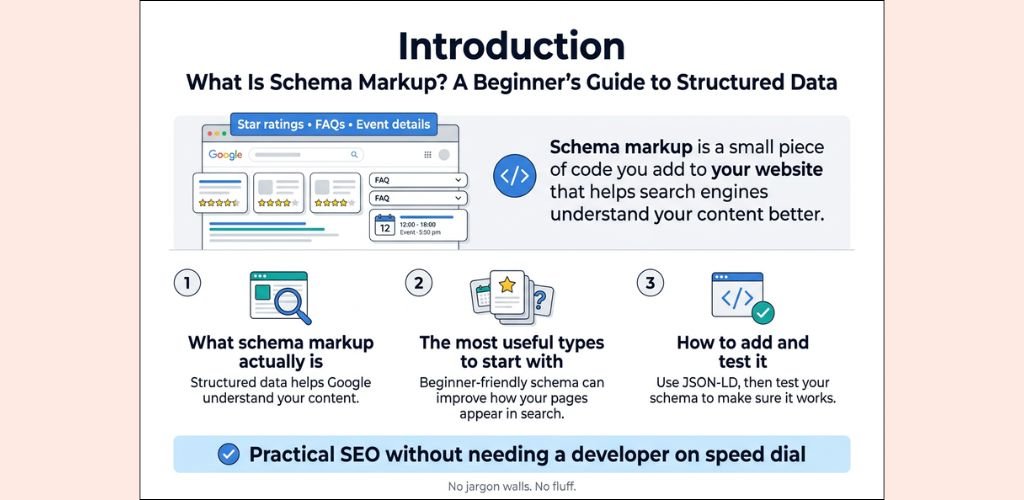
Schema markup provides search engines with additional context about your content, helping them understand what your pages cover and potentially display enhanced results. While schema doesn’t guarantee higher rankings, it increases visibility and can make your listings stand out with rich results like star ratings, FAQ sections, and product information.
Choose the appropriate schema type for your content. Common types include Article schema for blog posts, Product schema for e-commerce pages, Local Business schema for location-based services, and FAQ schema for question-and-answer content. Each schema type provides specific structured data that search engines can use to enhance your listings.
Implement schema using JSON-LD format, which is Google’s preferred method. Many content management systems offer plugins that simplify this process, but you can also add the markup manually. Focus on the most relevant schema properties for your content type rather than trying to implement every possible field.
Test your schema implementation using Google’s Rich Results Test to ensure it’s set up correctly. This tool identifies any errors in your markup and shows how your enhanced listing might appear in search results. Valid schema markup increases your chances of earning rich snippets that can improve click-through rates.
Common schema implementations include adding Article schema with author information, publish dates, and article sections. Product schema should include pricing, availability, and review data when applicable. Local Business schema requires accurate address, hours, and contact information to help with local search visibility.
Content Creation Strategy That Ranks
Building Topic Clusters and Pillar Pages for Authority
Now that we’ve covered the technical foundation and keyword research, and you’ve learned how to optimize a website for Google, content quality matters most. It’s time to focus on creating content that builds topical authority through strategic organization. Topic clusters and pillar pages represent a fundamental shift from the outdated approach of creating random blog posts to building interconnected content ecosystems.
The traditional method of picking individual keywords and writing isolated articles creates fragmented content that competes with itself rather than building authority. Search engines reward structure, consistency, and intent over scattered efforts. By organizing your content into topic clusters, you create a network of related pages that work together to establish your expertise in specific subject areas.
A pillar page serves as the comprehensive foundation piece that covers a broad topic in depth. Supporting articles then expand on specific subtopics, linking back to the pillar page and to each other. This structure signals to search engines that you have comprehensive coverage of a topic area, which can significantly boost your rankings across the entire cluster.
For example, a pillar article on “How to Audit Your Site for Accessibility Issues” might be supported by articles covering “The Complete Accessibility Checklist for Enterprise Websites,” “Common Accessibility Mistakes (and How to Fix Them),” and “How Accessibility Impacts SEO and User Experience.” Each supporting piece strengthens the authority of the entire cluster while targeting more specific long-tail keywords.
Creating High-Quality Content That Satisfies Search Intent
With your topic clusters planned, the next critical step involves creating content that genuinely satisfies what users are searching for. Understanding search intent goes beyond just identifying keywords—it requires deep comprehension of what users actually want to accomplish when they type a query.
Search intent typically falls into four categories: informational (seeking knowledge), navigational (finding a specific page), commercial (researching before buying), and transactional (ready to purchase). Your content must align with the specific intent behind your target keywords to achieve sustainable rankings.
The most effective approach involves studying the search engine results pages (SERPs) for your target keywords. Analyze what type of content currently ranks well—are the top results comprehensive guides, quick answers, product comparisons, or how-to tutorials? This SERP analysis reveals exactly what search engines believe satisfies user intent for those queries.
Quality content that satisfies search intent must also demonstrate expertise, experience, authoritativeness, and trustworthiness (E-E-A-T). This means including author bios from qualified experts, citing credible sources, providing up-to-date information, and maintaining accuracy throughout your content. Search engines increasingly favor content from reliable sources, especially for topics that impact health, finance, or safety.
Optimizing Content Length and Structure for Competition
Previously, we’ve established the importance of search intent, but content length and structure play equally crucial roles in outranking competitors. The optimal content length isn’t determined by arbitrary word counts but by how comprehensively you need to cover a topic to compete effectively.
Analyze your competition to understand the depth required for your target keywords. If top-ranking pages provide 2,000-word comprehensive guides, a 500-word article likely won’t compete effectively. However, longer content must maintain quality and relevance—padding articles with unnecessary information can hurt performance.
Structure your content with clear headings that guide both readers and search engines through your information hierarchy. Use H2 and H3 tags strategically to break up content into digestible sections while incorporating your target keywords naturally. Bullet points, short paragraphs, and visual elements improve readability and user experience.
The content experience extends beyond just the written word. Page loading speed, mobile responsiveness, clean design, and intuitive navigation all contribute to how search engines evaluate your content. A slow-loading page with poor mobile experience will struggle to rank regardless of content quality.
Internal linking structure within your content clusters helps distribute authority and keeps users engaged longer. Each piece should connect logically to related content, creating pathways that encourage deeper site exploration while reinforcing your topical expertise to search engines.
Maintaining Content Freshness and Regular Updates
With your content creation strategy in place, maintaining content freshness becomes essential for long-term SEO success. Search engines favor fresh, updated content over outdated information, making regular content maintenance a crucial component of sustainable rankings.
Establish a systematic approach to content audits, scheduling quarterly or biannual reviews to identify pages losing traffic or rankings. Update statistics with current data, rewrite outdated sections, and add new information that reflects industry changes or developments.
Content decay is a real phenomenon where previously high-performing content gradually loses rankings over time. This often occurs when information becomes outdated, competitors publish more comprehensive resources, or search algorithms evolve to favor different content types.
Don’t view updating existing content as an expense—consider it preserving your marketing assets. Well-performing content that receives strategic updates often regains and exceeds its original performance levels. Add new sections addressing emerging subtopics, incorporate recently developed best practices, and refresh examples with current data.
Track performance metrics to identify which content pieces would benefit most from updates. Pages that have dropped in rankings but still receive some traffic are often excellent candidates for refreshing. Focus your update efforts on content that historically performed well and addresses topics central to your business objectives.
Regular content maintenance also provides opportunities to improve internal linking as your content library grows. New articles create additional linking opportunities that can strengthen your topic clusters and distribute authority more effectively throughout your site.
Building Authority Through Quality Link Building
Creating Linkable Assets That Naturally Attract Backlinks
If you’re wondering how to do SEO yourself, link building is one area where consistency beats complexity. Creating content that naturally attracts backlinks requires developing assets that provide genuine value to your industry. Link bait that attracts backlinks passively is particularly effective because you don’t have to pitch prospects for every link opportunity manually.
The most successful linkable assets include original data, statistics pages, free tools, and calculators. These formats work because they give writers and researchers something concrete to reference when creating their own content.
A prime example is Bankrate’s compound savings calculator, which has attracted 893 backlinks from 200 referring domains. This calculator continues to earn new links almost daily because new articles on financial topics keep getting written, and their authors consistently find and cite this valuable resource.
When creating your own link bait, focus on solving problems or answering questions that your target audience frequently encounters. For original research, you can survey your own customers, analyze first-party data, or commission studies through third-party panels.
McKinsey’s state of AI report demonstrates how powerful original research can be, generating over 77,000 backlinks from 17,000 referring domains. This report works exceptionally well because it covers a relevant, timely topic, contains numerous graphs and visuals that people want to cite, and can be updated annually to maintain relevance and continue building new links.
The key to successful link bait is creating assets that don’t just earn links immediately after publication but continue attracting them over time as new content creators discover and reference your resource.
Effective Outreach Strategies for Guest Posting and Digital PR
Guest posting involves writing articles for other publications to reach their audience while potentially earning contextual links from trusted sources. Successful guest posting requires targeting established publications with real editorial standards, consistent traffic, and audiences that overlap with yours.
To find guest post opportunities, search Google for keywords in your niche combined with modifiers like “guest post,” “write for us,” “contribute,” “guest contribution,” or “contributing author.” Before pitching, verify the publication’s guidelines, as many limit backlinks or mark them as nofollow.
When pitching guest posts, personalize your approach by mentioning specific articles you’ve enjoyed from the publication. Present a clear, one-sentence pitch explaining your proposed angle and why it would resonate with their readers. Include examples of your previous work to demonstrate your writing quality.
Digital PR involves creating newsworthy assets and pitching them to journalists for editorial coverage. This strategy works because journalists need sources, and well-packaged assets with clear headlines provide exactly that. Effective digital PR assets include original research, surveys, data studies, or proprietary datasets that produce findings journalists can turn into stories.
Proprietary research is particularly valuable because it’s something no one else can recreate, making it a primary source that writers and researchers cite directly. When pitching digital PR, lead with your strongest finding in the subject line, then provide additional data points and context about why the story would be interesting for their specific beat.
Both guest posting and digital PR require consistent effort and genuine value creation, but they can result in high-authority backlinks from established publications when executed properly.
Local Link Building Tactics for Geographic Businesses
Local businesses can leverage their geographic presence and community connections to build relevant, authoritative links that boost both SEO performance and local visibility.
Partner and community links represent one of the most accessible strategies for location-based businesses. These links come from industry associations, technology partners, resellers, agencies you work with, and local organizations you’re affiliated with. Many of these sites maintain partner pages or resource sections where a link to your business would fit naturally – you often just need to ask.
Map out all your existing business relationships, including suppliers, integration partners, local business associations, and community organizations. These connections often have websites where featuring your business makes logical sense for their audience.
Community engagement through local forums, neighborhood websites, and location-specific social platforms can also generate valuable links. Reddit communities and niche Q&A sites relevant to your geographic area provide opportunities to share your content when it genuinely answers questions being asked.
The key is being a consistent, helpful presence in relevant local online spaces rather than simply dropping links without contributing meaningfully to conversations. While many community links carry “nofollow” or “ugc” attributes, these mentions still benefit your overall brand visibility, especially considering how heavily AI tools rely on these sources for local information.
Local businesses should also consider creating location-specific resources, such as area guides, local event information, or community statistics that other local websites would naturally want to reference and link to.
Avoiding Black-Hat Tactics That Can Harm Your Rankings
Understanding what constitutes harmful link building practices is crucial for maintaining your website’s search engine rankings and avoiding penalties that can devastate your organic visibility.
Black-hat link building tactics include paying for links, participating in link schemes, using automated link building tools, and acquiring links from spammy or irrelevant websites. These practices violate search engine guidelines and can result in severe ranking penalties or complete removal from search results.
Links from unreliable websites with no connection to your niche provide no SEO value and can actively harm your rankings. Google specifically penalizes websites that engage in manipulative link building practices, making it essential to focus on quality over quantity.
Avoid link farms, private blog networks (PBNs), and any service that promises hundreds of backlinks for a small fee. These tactics might seem appealing due to their low cost and quick results, but they inevitably lead to penalties that can take months or years to recover from.
Instead, focus on earning links through legitimate means that provide genuine value to other website owners and their audiences. This includes creating high-quality content that naturally attracts links, building authentic relationships with other businesses and content creators in your industry, and contributing meaningfully to relevant online communities.
When evaluating potential link opportunities, always ask whether the link would provide value to the linking site’s audience. If the answer is no, or if the arrangement feels forced or unnatural, it’s likely a tactic you should avoid.
Remember that link building should always feel natural and provide genuine value to users. Any strategy centered on manipulating search engines rather than serving users will ultimately harm your long-term SEO success.
Local SEO Optimization for Location-Based Businesses
Optimizing Google Business Profile for Maximum Visibility
Your Google Business Profile (formerly Google My Business) serves as the foundation of your local SEO strategy. An optimized profile helps your business appear in the local pack – the map-based results that Google displays for location-specific searches.
Start by claiming and verifying your business listing if you haven’t already. Complete every section of your profile with accurate business information, including your exact business name, address, phone number, website URL, and business hours. Add high-quality photos and videos that showcase your business, products, or services, as visual content significantly impacts user engagement and local rankings.
Select the most specific business category that matches your services, and add relevant secondary categories to capture additional search opportunities. Write a compelling business description that naturally incorporates local keywords while clearly explaining what your business offers and what makes it unique.
Regularly post Google Posts to share updates, promote special offers, and announce local events. These posts keep your profile active and provide additional opportunities to target local keywords while engaging with potential customers.
Building Consistent Local Citations and NAP Information
Local citations are online mentions of your business information across directories, review sites, and other platforms. Consistent Name, Address, and Phone number (NAP) information across all these sources signals to search engines that your business is legitimate and trustworthy.
Focus on building citations on general directories like Yelp, TripAdvisor, and Foursquare, as these platforms receive significant traffic and are widely recognized by search engines. Additionally, pursue industry-specific citations – for example, restaurants should consider platforms like DoorDash, while professional services might target industry-specific directories.
Maintain absolute consistency in how your business information appears across all citations. Even minor variations in formatting, abbreviations, or punctuation can confuse search engines and dilute your local SEO efforts. Regularly audit your existing citations to identify and correct any inconsistencies or outdated information.
Managing Online Reviews and Reputation
Online reviews are among the most important local SEO ranking factors, with businesses having higher numbers of positive reviews typically ranking higher in local search results. Reviews also build trust with potential customers and demonstrate your commitment to customer satisfaction.
Actively monitor reviews across all platforms where your business is listed. Respond to all reviews, both positive and negative, to show that you value customer feedback. For positive reviews, express gratitude and highlight specific aspects of the customer’s experience. When responding to negative reviews, address concerns promptly, offer to remedy the situation when appropriate, and demonstrate your commitment to improving your services.
Encourage satisfied customers to leave reviews by making the process easy and straightforward. Provide clear instructions and direct links to your review profiles. However, avoid incentivizing reviews or asking for only positive feedback, as this violates most platforms’ guidelines.
Creating Location-Specific Content and Landing Pages
Develop dedicated landing pages for each business location to help search engines understand that each location is a distinct entity. These pages allow you to create focused SEO efforts for each specific area you serve.
Incorporate location-specific keywords naturally throughout your content, including in main headings, subheadings, body text, and meta tags. Create content that demonstrates your connection to the local community, such as neighborhood spotlights, local event coverage, customer success stories from the area, and area-specific service guides.
If blogging makes sense for your business, publish locally relevant content that resonates with your community’s interests and needs. Cover topics like local events, community involvement, and location-specific tips or guides that establish your business as a valuable local resource.
Use internal linking to connect your location-specific pages with your main service pages, creating a strong site architecture that helps both users and search engines understand your local relevance and expertise.
SEO Tools and Analytics for Performance Tracking
Essential Free Tools Every Business Should Use
Google Search Console stands out as the most critical free tool for SEO performance tracking. This Google-provided platform offers essential data directly from the search engine, including performance reports showing clicks, impressions, and average position. It provides indexing status updates and alerts for critical issues that affect rankings, making it especially beneficial for small businesses and those starting their SEO journey.
The tool’s comprehensive performance insights allow you to understand how your website appears in search results and identify areas for improvement. Since it’s free and comes directly from Google, it provides the most accurate representation of your site’s performance in Google’s search results.
Key Metrics to Monitor for SEO Success
Now that we understand the importance of using the right tools, monitoring specific metrics is crucial for effective SEO tracking. Performance analysis should focus on understanding how your keywords rank to assess the effectiveness of your SEO strategy.
The most important metrics to track include:
- Keyword position tracking: Monitor daily changes in rankings to stay ahead of competitors
- Clicks and impressions: Understand how often your pages appear in search results and how frequently users click through
- Average position: Track your overall visibility in search engine results pages (SERPs)
- Competitor insights: Analyze competitors’ strengths and weaknesses to strategize effectively
Continuous monitoring helps identify trends in your rankings, revealing potential issues or areas for improvement. This data-driven approach ensures your SEO efforts remain aligned with search engine performance.
Setting Up Regular Reporting and Performance Reviews
With this comprehensive understanding of metrics, establishing regular monitoring habits becomes essential for long-term success. Make it a habit to check your rankings weekly or monthly, depending on your available resources and the competitiveness of your industry.
Leverage reporting features provided by tracking tools to share insights with your team and stakeholders. Regular reporting ensures everyone stays informed about SEO performance and can make data-driven decisions about future strategies.
For most businesses, checking SEO rankings at least once a month is advisable, though more competitive industries may require more frequent monitoring to stay competitive.
Using Data to Refine and Improve Your SEO Strategy
Previously established monitoring and reporting systems now enable strategic optimization based on actual performance data. Use the insights generated from your tracking tools to refine your keyword strategies and implement changes in your content approach.
The data collected should directly influence your SEO decision-making process. When you identify trends or changes in rankings, adapt your strategy accordingly. This might involve adjusting keyword targeting, improving content quality, or addressing technical issues that impact performance.
Cross-referencing data from multiple sources provides a more comprehensive understanding of your SEO performance. While free tools like Google Search Console provide excellent baseline data, combining insights from various tracking methods leads to better strategic decisions and more effective SEO implementation.
Common SEO Mistakes and How to Avoid Them
Technical Errors That Prevent Search Engine Access
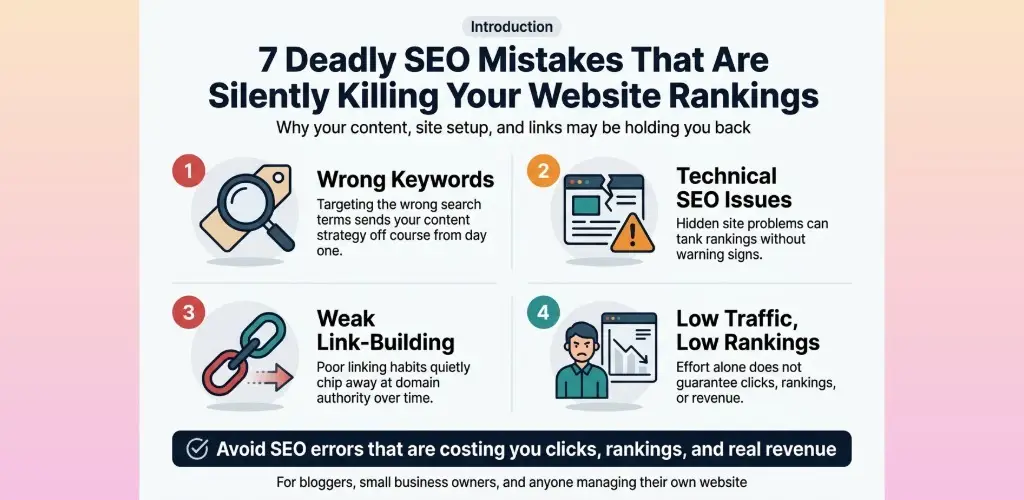
Technical SEO mistakes can completely block search engines from accessing and indexing your website content. These issues often go unnoticed but can devastate your rankings and organic traffic.
Duplicate Content Issues create confusion for search engines and can lead to indexing problems, wrong page versions appearing in search results, and poor or chaotic page rankings. Use tools like Site Audit to identify duplicate content across your website, then resolve issues by adding unique content, implementing canonical tags, or using 301 redirects to guide search engines to the preferred version.
Poor Crawlability prevents Google bots from properly accessing your webpages, blocking them from being indexed and appearing in search results. Common culprits include pages blocked in robots.txt files, broken links, redirect loops, 4xx and 5xx errors, and poor site architecture. Regular crawlability audits help identify these issues before they impact your search visibility.
Slow Load Speed is a confirmed Google ranking factor that significantly affects user experience. Users are much more likely to bounce from slow-loading pages, creating negative signals for search engines. Common solutions include image compression, HTML optimization, better hosting services, file minification, and enabling browser caching.Mobile Optimization Problems are particularly damaging since Google prioritizes mobile pages and the majority of searches occur on mobile devices. Implement responsive design, dynamic serving, or separate mobile URLs to ensure your site performs well across all devices.
Content Mistakes That Hurt Rankings and User Experience
Content-related SEO mistakes can severely impact your ability to rank well and provide value to users, even when your technical foundation is solid.
Low-Quality Content fails to meet Google’s evolving standards and user expectations. Search algorithms prioritize content that is accurate, relevant, readable, useful, grammatically correct, and credible with strong E-E-A-T (Experience, Expertise, Authoritativeness, Trustworthiness). Content must match user search intent, providing exactly what searchers intended to find when they used specific keywords.
Keyword Stuffing involves unnaturally cramming keywords into content, making it difficult to read and sending negative signals to Google. This practice can result in Google penalties, removing pages from search results entirely. Instead, use keywords naturally throughout your title, meta description, opening paragraph, body content, alt tags, and headers where they make contextual sense.
Keyword Cannibalization occurs when multiple pages on your website target the same keywords, causing them to compete against each other and weakening both pages’ rankings. Research search intent behind your target keywords and create unique content that serves distinct purposes for different user needs.Under-Optimized Meta Tags represent missed opportunities to improve search performance. Missing, duplicate, or poorly crafted title tags and meta descriptions fail to help Google understand your content or entice users to click through from search results. Optimize these elements by including target keywords, keeping appropriate lengths, and creating unique, compelling descriptions for each page.
Strategic Missteps That Waste Time and Resources
Strategic SEO mistakes often stem from focusing on the wrong priorities or misunderstanding how search engines actually work, leading to wasted effort and resources.
Targeting Wrong Keywords is one of the most common strategic errors. Many businesses attempt to rank for overly generic, highly competitive keywords where they have little chance of success. Instead of competing with established companies for broad terms like “rental car,” focus on long-tail keywords that are more specific and achievable. These longer, more specific phrases often indicate clearer search intent and convert better, even with lower search volumes.
Neglecting User Experience Elements like call-to-actions, internal linking, and mobile optimization can undermine your SEO efforts. Once visitors land on your site, you need strategies to keep them engaged and guide them through your content. Poor user experience signals like high bounce rates can negatively impact your search rankings.
Over-Optimized Anchor Text in internal and external links can appear manipulative to search engines. Instead of using keyword-rich anchor text repeatedly, focus on natural, descriptive link text that clearly indicates what users will find on the destination page. Google rewards websites that prioritize user experience over algorithmic manipulation.
Ignoring Image Optimization wastes opportunities for additional traffic and can slow down your site. Missing alt text prevents accessibility and reduces context for search engines, while oversized images hurt page speed. Broken images create poor user experiences and signal low-quality content to search engines.
Unrealistic Expectations About SEO Results and Timeline
Having unrealistic expectations about SEO can lead to premature strategy changes, inadequate resource allocation, and frustration with otherwise effective optimization efforts.
SEO is inherently a long-term strategy that requires consistent effort and patience. Unlike paid advertising, organic search results don’t appear overnight, and ranking improvements often take months to materialize significantly. Many businesses abandon effective SEO strategies too early because they expect immediate results similar to other marketing channels.
Expecting Overnight Success is perhaps the most damaging expectation. Quality SEO requires time for search engines to crawl, index, and evaluate your content against competitors. Building domain authority, earning quality backlinks, and establishing topical expertise all require sustained effort over time.
Perfectionism Paralysis can prevent you from making necessary improvements while waiting for ideal conditions. SEO is an iterative process where small, consistent improvements compound over time. Focusing on perfect optimization before publishing content often delays important progress.
Assuming Set-and-Forget Results ignores the dynamic nature of search algorithms and competitive landscapes. SEO requires ongoing monitoring, adjustment, and improvement as search engines evolve, competitors adapt, and user behavior changes. Regular audits and updates are essential for maintaining and improving search performance.
The key to successful SEO lies in understanding these common mistakes and implementing systematic approaches to avoid them. Regular monitoring with tools like Site Audit helps identify issues before they significantly impact your search visibility and organic traffic.
Scaling Your SEO Efforts and Maintaining Long-Term Success
Building a Sustainable SEO Strategy for Continuous Growth
Now that you’ve implemented your initial SEO foundation, creating a sustainable strategy becomes crucial for maintaining long-term success. A scalable SEO approach requires structured planning that evolves with your business and the search landscape.
Build your sustainable strategy using a comprehensive 7-step framework. Start with a complete audit of your current SEO performance across all properties, evaluating technical infrastructure, content performance, and competitive positioning. This baseline assessment ensures your scaling efforts build on solid foundations rather than amplifying existing weaknesses.
Research keywords across every platform your audience uses, extending beyond Google to include voice search, video platforms, and AI-driven channels. Map these keywords to different stages of the buying process, prioritizing based on business impact and competition levels. This multi-platform approach prevents traffic plateaus that many businesses experience when relying solely on traditional search.
Develop content pillars using a hub-and-spoke model where comprehensive pillar pages link to specific cluster content. This topical authority approach demonstrates expertise to search engines while providing seamless user experiences. Assign ownership of each pillar to subject matter experts to maintain accountability within your production workflow.
Implement 90-day sprint cycles for agile execution, breaking annual plans into manageable quarterly objectives. This approach maintains strategy flexibility while allowing adjustments based on performance data, algorithm changes, or shifting business priorities. Regular cross-team communication ensures dependencies are managed effectively.
When to Consider Professional SEO Help vs DIY Approach
Determining when to scale your SEO efforts internally versus seeking professional help depends on several key factors that signal your current capacity limitations.
Consider professional SEO assistance when you’ve hit a traffic plateau despite consistent optimization efforts. This typically indicates your current strategy has reached its performance ceiling and requires advanced techniques or specialized expertise to break through.
Algorithm updates that cause significant ranking drops are another clear indicator for professional intervention. Search engines regularly update their algorithms, and recovering from these changes often requires deep technical knowledge and experience with recovery strategies that go beyond basic optimization.
Business expansion phases demand immediate scaling consideration. When adding new products, services, or entering new markets, your SEO strategy must grow accordingly. Professional teams can implement scalable frameworks quickly, ensuring you don’t miss critical opportunities during expansion phases.
Resource allocation becomes critical when your team lacks specific skills for technical implementation, advanced content strategy, or cross-functional coordination. Small businesses particularly benefit from professional planning, as it optimizes limited resources and avoids redundant efforts that drain budgets without delivering proportional results.
Professional help becomes essential when you need sophisticated tools integration, competitive intelligence analysis, or multi-platform optimization beyond Google. These advanced requirements typically exceed the capabilities of basic DIY approaches and require specialized expertise to implement effectively.
Staying Current with Algorithm Updates and Industry Changes
The search landscape evolves rapidly with AI-driven experiences, voice queries, and zero-click results reshaping how users find information. Forward-thinking SEO strategies must adapt while preserving focus on user value and business objectives.
Optimize for zero-click search results by targeting featured snippets, knowledge panels, and AI-generated summaries. Success in this environment requires structured content that directly answers common questions and maintains brand visibility even when users don’t click through to your website.
Implement comprehensive schema markup to help AI systems interpret your content effectively. Prioritize schema based on business objectives, ensuring AI models accurately represent your brand and services. Content structure markup, business entity markup, and product information schemas become essential for maintaining visibility in AI-powered search results.
Plan multi-platform SEO strategies beyond Google, as search behavior diversifies across voice assistants, video platforms, and social media channels. Resource allocation should reflect channel importance, with performance measured through engagement and reach metrics specific to each platform.
Stay ahead of voice search optimization by incorporating conversational keywords and local search targeting. Video platform SEO requires platform-specific optimization strategies, while social media search demands understanding of LinkedIn, TikTok, and emerging channel algorithms.
Monitor industry changes through reliable SEO publications, attend professional conferences, and maintain connections with SEO communities. These information sources provide early warnings about algorithm updates and industry shifts before they impact your rankings significantly.
Creating Your Actionable SEO Implementation Plan
Transform your SEO strategy into executable actions by establishing clear workflows that connect daily tasks to strategic objectives. Effective implementation requires structured coordination across marketing, content, and development teams.
Design cross-functional SEO workflows that map how initiatives move from planning to production to reporting. Clear ownership and standardized processes reduce confusion while maintaining momentum. Role definitions should establish responsibilities across strategy development, content creation, technical implementation, and performance measurement.
Manage dependencies between interconnected SEO tasks by identifying critical paths that directly impact delivery timelines. Content depends on keyword research, technical updates rely on design input, and reporting requires accurate tracking implementation. Careful sequencing prevents delays and protects project timelines.
Use impact versus effort matrices to prioritize which projects tackle first. High-impact, low-effort wins like optimizing existing high-performing content provide quick returns while strategic investments in long-term authority building establish sustainable growth foundations.
Establish resource allocation based on skills and team capacity, allowing content campaigns and technical projects to progress simultaneously. Cross-training team members improves workflow velocity and reduces bottlenecks that typically slow implementation.
Create executive dashboards that translate technical SEO data into business insights leadership values. Focus on growth metrics, revenue attribution, and market share rather than granular technical details. These dashboards should connect SEO metrics directly to revenue and customer acquisition costs, demonstrating clear ROI to stakeholders.
Implement automation for repetitive SEO activities, starting with performance reporting and content optimization templates. This efficiency gain allows teams to focus on higher-impact strategic initiatives rather than manual tasks that consume valuable time.
FAQ
>How to do SEO for website step by step for beginners
Start with keyword research using tools like Semrush’s Keyword Magic Tool to identify relevant search terms your target audience uses. Enter a word or phrase related to your business, choose your country, and click “Search” to find keywords sorted by search volume.
Next, ensure your website is technically sound by checking if Google can crawl and index your content. Use Google Search Console to inspect URLs and verify they appear in Google’s index. If pages aren’t indexed, request indexing or resolve technical issues like robots.txt blocks.
Create high-quality content that satisfies searchers’ needs while incorporating your target keywords naturally. Focus on relevance, quality, and usability – the three most important Google ranking factors. Optimize your content length based on competitor analysis, aiming for depth that truly helps readers.
>How to begin search engine optimization for a new website
For new websites, it can take up to a year for Google to determine proper rankings, with strong fluctuations expected initially. Start by setting up essential technical foundations including XML sitemaps, robots.txt files, and ensuring mobile-friendly responsive design.
Submit your XML sitemap to Google Search Console and Bing Webmaster Tools to help search engines understand your site structure. Install Google Analytics to monitor traffic, organic rankings, and user behavior from day one.
Focus on creating content around keywords with low difficulty scores (KD% of 0-29) to give your new site the best chance of ranking. Build authority gradually through quality content creation and earning backlinks from reputable sources in your industry.
>Step-by-step SEO checklist for website optimization
Technical SEO Foundation:
- Ensure fast page loading speeds (aim for Performance scores of 90+ on Google PageSpeed Insights)
- Implement responsive design for mobile optimization
- Create and submit XML sitemaps
- Set up proper robots.txt files
- Use HTTPS security
Content Optimization:
- Conduct keyword research for each page
- Optimize title tags and meta descriptions with target keywords
- Use header tags (H1, H2, H3) strategically
- Create content with appropriate word counts (analyze competitors for guidance)
- Include internal links (no more than one link per 400-450 words)
Monitoring Setup:
- Install Google Analytics and Google Search Console
- Set up Bing Webmaster Tools
- Use SEO audit tools like Semrush’s Site Audit to identify technical issues
>Step-by-step guide to improving website visibility organically
Begin by analyzing your current search performance using Google Search Console to identify which pages need improvement. Check for 404 errors, crawl issues, and indexing problems that may be limiting visibility.
Improve your content by satisfying search intent – create content that truly answers what users are searching for. Use Semrush’s SEO Content Template to get recommended word counts and semantically related keywords based on top-ranking competitors.
Build authority through quality link building by creating content that naturally attracts backlinks. Focus on producing original research, useful infographics, and helpful content that relevant publishers want to share. Avoid buying links, as this violates Google’s guidelines and can result in penalties.
>Best SEO tools to use for improving website ranking
Keyword Research and Analysis:
- Semrush Keyword Magic Tool for comprehensive keyword research
- Keyword Overview tool for competition analysis and difficulty scores
- SEO Content Template for content optimization recommendations
Technical SEO Tools:
- Google Search Console (free) for indexing status and technical health
- Google Analytics (free) for traffic monitoring and conversion tracking
- Semrush Site Audit for identifying technical SEO errors across 140+ checks
- Google PageSpeed Insights for page speed optimization
Content and Link Building:
- SEO Writing Assistant for real-time content optimization
- Backlinks tool for competitor link analysis
- Link Building Tool for prospect identification and outreach management
- Backlink Audit tool to identify potentially harmful links
>How to create an SEO strategy for a new website
Start with comprehensive keyword research to identify topics your audience searches for. Use tools like Semrush’s Keyword Magic Tool to find keywords with good search volume and low competition, focusing on long-tail keywords that are easier to rank for initially.
Analyze search intent to determine what searchers actually want when using specific keywords. This helps you choose appropriate content formats and create content that truly satisfies user needs.
Develop a content calendar based on your keyword research, prioritizing pages that target low-difficulty keywords first. Plan your site architecture with clear navigation and internal linking structure to help search engines understand your content relationships.
>Finding relevant long-tail keywords for content strategy
Long-tail keywords contain multiple words and target more specific search queries. Use Semrush’s Keyword Magic Tool by entering broad terms related to your business, then filter results to find longer, more specific variations with lower competition.
Look for keywords with KD% scores of 0-29 (Very Easy-Easy difficulty) to maximize your chances of ranking. These longer phrases often have higher conversion potential because users searching with specific terms typically have clearer intent.
Analyze the “Questions” and “Related” tabs in keyword research tools to discover natural long-tail variations that people actually search for. These question-based keywords are particularly valuable for creating FAQ sections and comprehensive guides.
>Affordable SEO services available for small businesses in India
While the reference content doesn’t specifically address SEO services in India, it mentions that technical SEO typically requires help from specialists or web developers. Small businesses should focus on cost-effective approaches like using free tools such as Google Search Console and Google Analytics for basic monitoring.
Consider using Semrush’s Agency Partners directory to find qualified SEO professionals who can help with technical implementation and link building outreach. Many tasks like content creation and basic on-page optimization can be handled in-house with proper training and tool access.
Prioritize high-impact, low-cost activities like optimizing existing content, fixing technical issues identified through free tools, and creating quality content that naturally attracts links rather than expensive link-buying schemes.
>Best practices for optimizing website page titles and meta descriptions
Page titles should include your primary keyword naturally while remaining compelling for users. Keep titles under 60 characters to ensure they display fully in search results. Each page should have a unique title that accurately describes the content.
Meta descriptions should provide a concise summary of page content in 150-160 characters, incorporating relevant keywords naturally. While meta descriptions don’t directly impact rankings, they influence click-through rates from search results.
Use header tags (H1, H2, H3) strategically to structure your content and include keywords in subheadings where appropriate. Ensure each page has only one H1 tag that contains your primary keyword and clearly describes the page topic.
Avoid duplicate titles and meta descriptions across your site, as this can confuse search engines about which page to rank for specific queries. Use tools like Semrush’s Site Audit to identify and fix duplicate content issues.
SEO success in 2026 requires a methodical approach that balances technical excellence with user-focused content creation. From establishing a solid technical foundation and conducting strategic keyword research to optimizing on-page elements and building quality backlinks, each component works together to create sustainable organic growth. The businesses that thrive understand that SEO is not a one-time task but an ongoing investment that compounds over time, typically showing meaningful results within 3-6 months of consistent effort.
Whether you choose to handle SEO yourself or partner with professionals, the fundamentals remain constant: create technically sound websites, develop content that genuinely serves your audience, and build authority through quality and consistency. Start with the immediate actions outlined in this guide—set up Google Search Console, conduct your first technical audit, and begin keyword research. Remember that the best time to start SEO was years ago, but the second-best time is today. Take the first step, maintain consistency, and measure your progress as you build a sustainable competitive advantage through organic search.